How electrifying the brain wards off Parkinson's disease
Implanting electrodes in the brain and zapping it helps patients with Parkinson's and otherdisorders, but doctors have never been sure why, exactly. Now, researchers from UC San Francisco think that the therapy (called deep-brain stimulation, or DBS) works by altering neural timings, in much the same way a defibrillator resets heart rhythms. In a healthy brain, neuron firing is controlled by low frequency rhythms that sync up movement, memory and other functions. But the UC team found that the synchronization is too strong in Parkinson's patients, making it harder for them to move voluntarily.
The brain needs a balance between autonomy and rhythm, which is where DBS comes in. The implants appear to lower the overly lock-step synchronization, improving patient coordination and other symptoms. But the invasive, six-hour-long surgery requires implanting probes into deep brain structures and the patient must be awakened mid-surgery to test it out -- so anything that can make it more effective is helpful. According to the researchers, "we can (now) begin to think of new ways for stimulators to be automatically controlled by brain activity, which is the next innovation in treatment for movement disorders."
Tuesday, April 14, 2015
Netflix gives blind fans of Daredevil the audio descriptions they asked for
Audio descriptions are coming soon to Netflix's other original shows
Netflix is doing more to make its service accessible to blind customers and those who are visually impaired. Today, the company announced that it's rolling out audio descriptions, which are narration tracks that describe "what is happening on-screen, including physical actions, facial expressions, costumes, settings and scene changes." The first series to get audio descriptions is Netflix's newest (and very good) original series Daredevil, and it's something comic book fans have been asking for. To feature an original series starring a blind protagonist — while not doing all it could to accommodate blind customers — has recently put Netflix's lacking accessibility options through fresh scrutiny.
But the company says audio descriptions will quickly be expanded beyond just Daredevil to include House of Cards, Orange is the New Black, Unbreakable Kimmy Schmidt, and Marco Polo. Narration tracks for those shows will be added in the "coming weeks," and Netflix says customers can access them like any other alternate audio track. Netflix isn't stopping with its own original programming though, pledging that it's "actively committed to increasing the number of audio-visual translations for movies and shows" in a blog post today. Discussions with studios and content owners to move that effort along are ongoing, and Netflix is "also exploring adding audio description into other languages in the future."
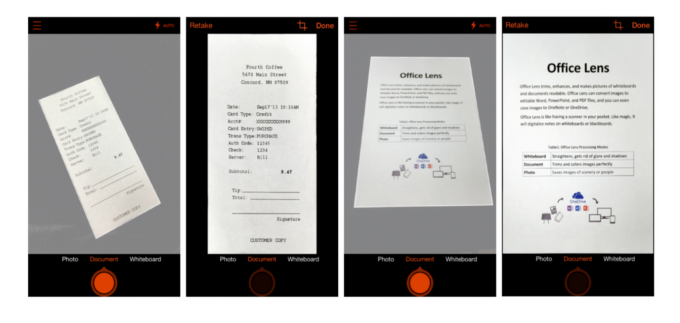
Microsoft today launched Office Lens, a mobile document scanner app that works with OneNote, for iOS and Android smartphones. The app, which allows users to snap photos of paper documents, receipts, business cards, menus, whiteboards, sticky notes and more, was first launched a year ago as an application designed only for Windows Phone devices.
But in conjunction with the company’s newer strategy to embrace other platforms outside its own, the app has now arrived on Apple’s App Store and on Android phones, where it will sit alongside dozens of other Microsoft applications, including Office and Outlook.
Office Lens’ core functionality itself is not all that different from a number of document-scanning applications on the mobile app stores today, like Scanner Pro, TinyScan Pro, Scanbot and more. And much like Evernote’s Scannable app, for example, it exists more as an add-on or complement to a larger, more prominent product – in Microsoft’s case, OneNote.
Like most scanner apps, Office Lens identifies the text on the images it captures using optical character recognition (OCR), which allows you to later locate the file in question using keyword search in OneNote or in Microsoft’s cloud storage site, OneDrive. You can also convert the images you scan of paper files and whiteboards into Microsoft Office formats and more, including Word documents, PowerPoint presentations and even PDFs and JPGs. These can be inserted into OneNote as images, the company says.
In addition, Microsoft says that Office Lens offers a business-card scanning function that lets you turn cards into contacts you can add to your smartphone’s address book. That initially sounds similar to the functionality that Evernote Scannable offers, you’ll think. However Evernote also pulls in LinkedIn details, which is handy as it allows you to grow your network. (LinkedIn used to offer its own card-scanning app, but later shut it down and pointed people to Evernote instead.)
But with Office Lens, the process of turning cards into contacts is more involved than with Scannable. As a previous Microsoft blog post explained, it still involves the use of OneNote. That is, OneNote is able to recognize the contact information on the card, then you can open the attached VCF file from the OneNote app to save the contact details to Outlook or your phone’s contact list.
In Scannable, by way of comparison, you simply tap one button to save the scanned card to your phone’s contacts. That makes Scannable the better option for those looking mainly for a business card scanner, while Office Lens is really about catering to the heavy OneNote-using crowd instead.
Also like Evernote Scannable, Microsoft’s app also offers the ability to create an online archive of your scans in its own OneDrive service.
The new Office Lens app is available on the iTunes App Store for iOS users, while Android users are being asked to join the “preview” for the product via Google+. From here, they’ll be able to test the version ahead of its public debut.
The release comes at a time when Microsoft, a historically more closed company that tried to keep customers in its own ecosystem, has been expanding to other platforms besides its own.
For the first time, researchers can improve the way humans walk without using an external power source, according to a studypublished in Nature today. A boot-like exoskeleton that fits into a regular running shoe reduces the energetic costs of walking by about 7 percent. In short, it makes walking less tiring without resorting to a battery pack or a motor — something that could really come in handy for people who have trouble walking, or military personnel in remote areas.
THEY IMPROVED HUMAN WALKING — WITHOUT A POWER SOURCE
"Our study shows that walking, a highly evolved human task, can be improved by manmade technology and engineering," says Gregory Sawicki, a co-author of the study and a physiologist at North Carolina State University. "That’s what’s so exciting for us."
A 7 percent reduction in the energy cost of walking isn’t entirely new: researchers have achieved similar gains in the past. In 2013, a group of researchers achieved a 6 percent reduction in energy costs thanks to an air compression system. Others have worked on exoskeletons that are powered by motors and battery packs. But the device that Sawicki and his team came up with doesn’t need any of that; it's unpowered. It makes walking less tiring by rerouting the energy that normally goes through your calf muscles and tendons into carbon fibre, metal — and a very basic spring.
"It’s sort of been a grand challenge in the field," Sawicki says. "All the way back to graduate school, we had our eyes on this — and whether or not this was even possible."
"IT’S SORT OF BEEN A GRAND CHALLENGE IN THE FIELD."
Unlike most muscles, the calf muscle doesn’t "turn on" by shortening itself and contracting. Instead, is provides a rigid link upon which the Achilles tendon can stretch and recoil. This is what the exoskeleton is replicating thanks to a system of springs and clutches. When the heel strikes the ground — a time when the Achilles tendon would normally hold onto the calf muscle with a high force — the clutch holds on to the spring of the exoskeleton. "From that point on, the forward momentum of your body is exchanged with the stretch of the spring; the spring kind of catches your forward movements," Sawicki says. This means that when the spring stretches some of the energy of the human body is transferred into it.
Collins, et al (2015)
The device is also super light weight. That means that the there’s no significant mass penalty that needs to be factored into the energy gains you get from wearing the exoskeleton on both legs. "The device weighs between 300 and 500 grams, which is a little heavier than your really lightweight running shoes," Sawicki says. "It’s about the weight of a normal dress loafer."
"The reported savings are impressive," says Heike Vallery, a biomechanical engineer at the Delft University of Technology in the Netherlands who didn't take part in the study. Art Kuo, a University of Michigan biomechanial engineer, also thinks that the findings are sound, but cautions that this is only a first step — medical applications are still far away, he says.
Others wonder how the device will fair with everyday use. "It isn't clear how the device would respond to non-rhythmical cyclic tasks," says Daniel Ferris, a biomedical engineer, also at the University of Michigan. Energy savings might not occur during tasks like standing, turning maneuvers, sit-to-stand and stand-to-sit motions. Still, Ferris thinks that the exoskeleton could prove useful for people who have reduced ankle strength — people with incomplete spinal cord injuries, the elderly, and people who suffer from multiple sclerosis, for instance.
Using the boot isn’t very hard, Sawicki says. "After 20 minutes or so, most people aren’t conscious of it; it gets integrated into their being." The only time users notice it is when they take it off. "There’s this heavy leg feeling after, that lasts for up to five minutes for some people," he says. "You feel like your leg is collapsing under you."
WHEN YOU TAKE IT OFF, "YOU FEEL LIKE YOUR LEG IS COLLAPSING UNDER YOU."
This hints at something that researchers will undoubtedly have to investigate: what are the effects of wearing the exoskeleton for long periods of time, on a regular basis? Given what happens when people spend a lot of time in wheelchairs, it’s possible that a user's leg muscles would become weak with extended use. "My instinct is to say that if you wore it all the time, the body would recognize the parallel pathway, and the morphology of your leg would change," Sawicki says. But "we just don’t know yet."
It took over five years to come up with this design. And the fact that they were able to do this at all has a lot to do with advancements in medical imaging techniques. "That whole 'clutch-holding and Achilles-stretching' thing — we didn’t know about that until the late 2000s, when people were started using ultrasound imaging to look at what muscles were doing," Sawicki says. Thanks these techniques, researchers were able to see that the calf muscle and the Achilles tendon were acting like the clutch and spring in the exoskeleton. "It changed the way we look at exoskeletons."
There’s a lot that the exoskeleton can’t do right now; it really only works at certain speeds. "The device in the paper will break during running," Sawicki says. The researchers still have to find a way to make a sturdier (and bulkier device) that can withstand harder impacts. Different materials, like electroactive polymers, might help them do that. "We need to build a device that can do it all."
Still, if all you want to do is go for a walk, the exoskeleton can help. People who like to go hiking might want to wear it, Sawicki says. The exoskeleton might also prove useful for military personnel. But what the team is really interested in are the medical applications. "It could be a mobility aid for people who have had a stroke," Sawicki says. Given the regulations surrounding medical devices, the exoskeleton might end up making it to market as a recreational device first, however. Sawicki thinks that the final product would cost a little under $1,000.
"EVEN IF WE COULD BUILD IRONMAN, HOW PRACTICAL WOULD IT BE FOR REGULAR USE?"
But before the researchers can think of marketing the exoskeleton to hikers, Sawicki and his team will have to come up with a name. They’re open to suggestions, he told The Verge. You might want to stay away from superhero references, however. "I love science fiction and stuff — I think it has provided a lot of motivation for our field — but it’s so far removed from where we are in the field in terms of capability," Sawicki says. Moreover, making a superhero suit doesn't align very well with what the researchers are trying to achieve. "Even if we could build Ironman, how practical would it be for regular use? People wouldn’t be able to afford it. We want to make things that are simple and accessible to a large amount of people."
When Faith Lennox was nine months old, she lost her left hand. Now at age seven, she's getting one custom made by a 3D printer. It's called a 'robohand'. She got to pick the colors and watch the printing process firsthand at Build It Workspace, a 3D printer studio in California.
Build It's Mark Lengsfeld thinks the technology will revolutionize prosthetics, especially in children who outgrow prosthetic limbs or have trouble using them due to size and weight.
Eric Dolan’s family knows illness, and it knows helplessness. Like many families with several members affected by chronic disease, symptoms and surgeries compounded at the same, exposing many of the vulnerabilities in the health care system. Long before the mobile revolution, Dolan noted that his family lacked the necessary tools to properly track symptoms and the qualities that exacerbate them.
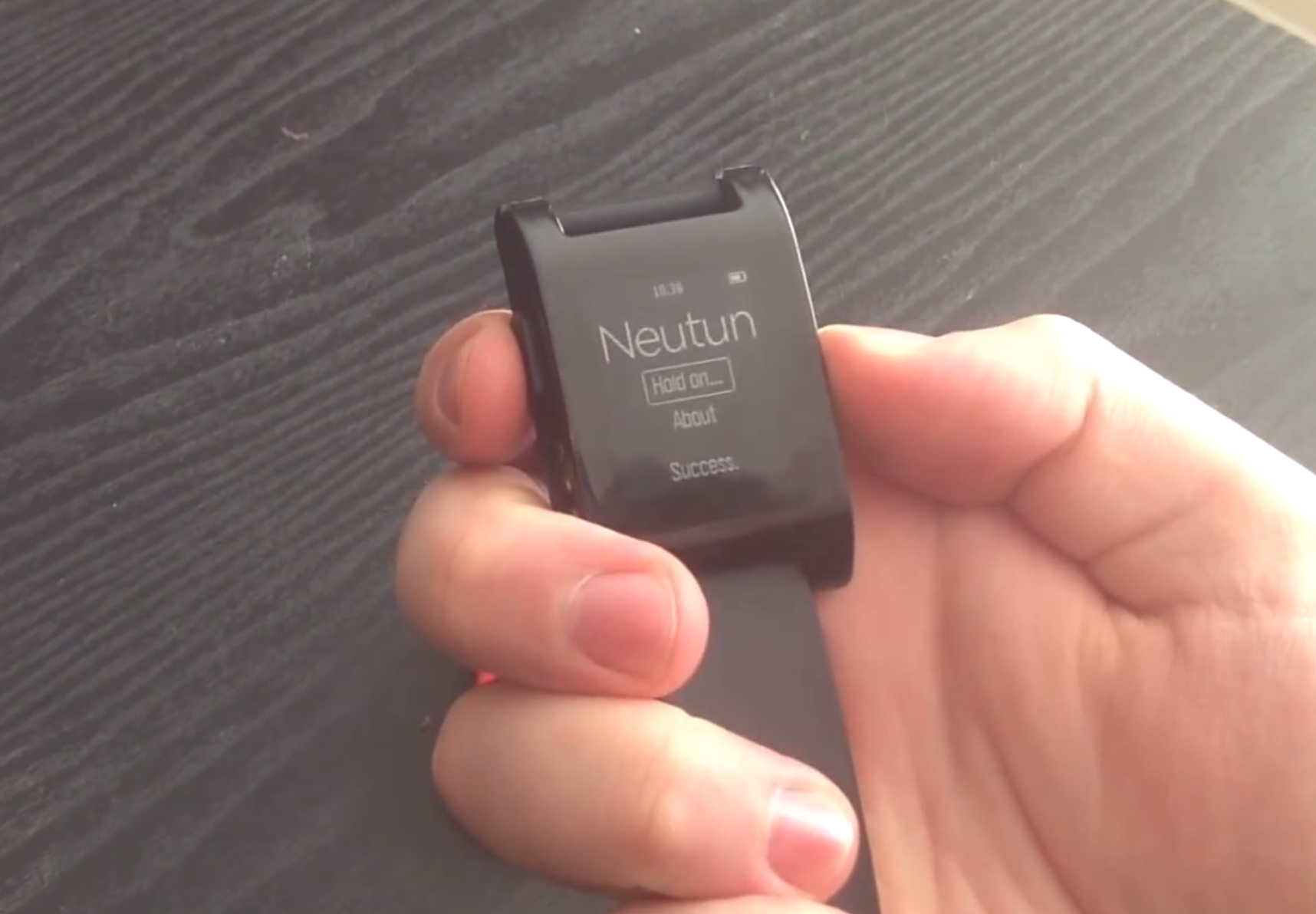
Thirteen years later, Dolan and his brother Alex have cofounded a company, Neutun (pronounced ‘Newton’) to improve the quality of life for epilepsy sufferers. Conceived at Hack The North last fall, the idea was to use the accelerometer in the inexpensive smartwatch to accurately track seizures.
“The last couple of years, we’e been trying to put together different solutions [for tracking], but we always felt it wasn’t there. With a lot of other healthcare stuff, there were always forms, and everything was self-inputted,” Dolan tells me from his office at the Ryerson DMZ in Toronto.
Dolan says that the opportunity to read the data from a smartwatch accelerometer, which due to its placement on the wrist tracks human movement far more accurately than the smartphone in one’s pocket, was a perfect opportunity to track diseases like epilepsy that involve involuntary movement like seizures. “The accelerometer makes day-to-day tracking easy,” he says, and much cheaper.
At Hack The North, which takes place every September in Waterloo, Dolan conceived of using Pebble’s open API to stream accelerometer info in real-time to a database. After pitching the idea, at the time called ‘Pebblepsy’, to YCombinator and Pebble, Dolan caught the attention of Eric Migicovsky, Pebble’s founder and CEO, who recognized in the project the potential to change peoples’ lives.
Eventually, Dolan quit his startup job and founded Neutun, launching earlier this year.
“People with diseases like this get put in a box of sorts,” making it difficult to shake the stigma of being damaged or incomplete. Neutun’s goal is to empower epileptics by combining a web-based front-end for tracking daily symptoms and goals with real-time data from a smartwatch that, over time, can offer insights about the disease.
Like step counting or fitness tracking, the data is only as good as the tools that synthesize it. Neutun uses the notion of a false-positive to generate an alert when a Pebble wearer begins convulsing. The wearer has 15-seconds to dismiss the notification before a text message or email is automatically sent to predetermined emergency contacts. The message contains a GPS location and information about the person.
Because Dolan was already using Pebble’s back-end tools, he felt adding the smartwatch app through Pebble’s iOS or Android app was enough — a standalone smartphone solution wasn’t necessary.
Tools like Neutun are timely. With Apple’s recent ResearchKit announcement, the ability to perform clinical trials is being decentralized and expanded. “There’s such a lack of data out there, and the more there is the better we can adjust each person’s threshold to their personal levels.”
“People take their health very seriously,” says Dolan, and tools like Neutun, and those being proffered by ResearchKit are just the beginning of a trend towards improving health with smartphones and wearables like Pebble.
You'll see a lot moreinstances of roboticarms in the news, but it doesn't mean high-tech prostheses for the lower limbs don't exist. The Cyberlegs project, for instance, is developing robotic legs that can help amputees move and walk more naturally. Each system is comprised of smart shoes equipped with pressure sensors and inertial measurement units, the limb itself, as well as a component and algorithm that can decode how the user intends to move. It can, for instance, tell if the user wants to start walking, to get up or to sit down -- based on the amputee's habits -- providing the proper support for each action. Users that need even more help can also be fitted with an accompanying pelvic brace that can assist them in moving their hips.
Cyberlegs is a joint project by a number of European institutions: the University of Ljubljana in Slovenia, Scuola Superiore Sant'Anna di Pisa, Fondazione Don Carlo Gnocchi Onlus in Florence, as well the Catholic University of Louvain and the Free University of Brussels in Belgium. Researchers from these schools have been working on the project since 2012 using $2.7 million in funds from the European Commission, but the Italian scientists have only just presented their work to the public this Monday.
Thus far, the system has already been tested by 11 people. But when the team got together recently to assess their work, they've determined that they still need to reduce the prosthetic's weight and size for comfort. The team is hoping to get additional funds from industrial partners to make that happen and to bring Cyberlegs to market in two to three years' time.


/cdn0.vox-cdn.com/uploads/chorus_asset/file/3564384/Screen_Shot_2015-04-01_at_12.34.35_PM.0.png)