Friday, August 12, 2016

Virtual reality programs could help paralyzed patients walk again

Utilizing both virtual reality and brain-interface systems, researchers were able to help patients regain some motion.
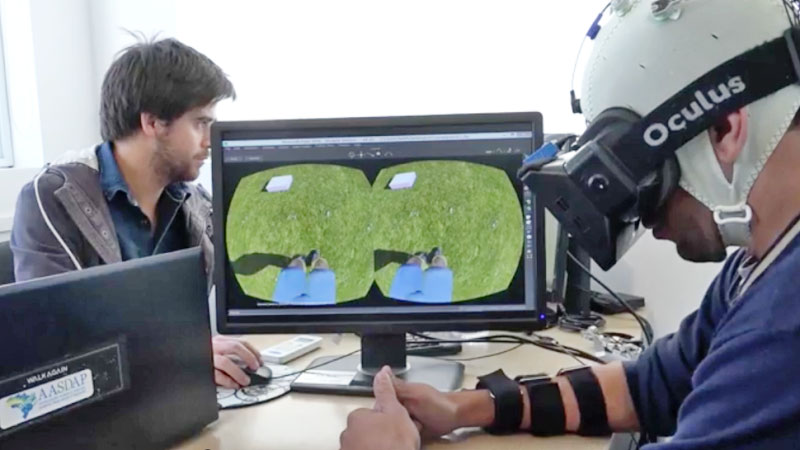


Results from a recent experiment have demonstrated that special brain-machine interfaces, when used in addition to exoskeletons and virtual reality, could very well help paralyzed patients regain movement after spinal cord injuries. In short, virtual reality physical therapy could eventually help patients to walk again.
The system and its resulting experiments, conducted by Duke Universityneuroscientist Miguel Nicolelis and his colleagues, was successful in opening up partial restoration of muscle control and sensations in patients's lower limbs. This was possible after the patients were put through an aggressive training regiment with brain-controlled robotics andVR technology. This level of recovery is unprecedented in patients with long-term paralysis, according to the research, and was successful in restoring some sensation to eight patients previously diagnosed with spinal cord injuries.
The training programs utilized brain-machine interfaces (BMIs) in conjunction with virtual reality tech to establish communication between the brain and a computer, which gives patients control over external devices using only their mind. Virtual reality assisted patients with visualizing the brain-controlled movements and mind-body awareness. With a representation of their own bodies they were able to better make a connection between VR and their physical beings to make the training regimen more successful.
Patients regained varying amounts of sensation, ranging from some feeling and muscle control to an astonishing ability to move in a 32-year-old woman who had been paralyzed for 13 years. She was able to move her legs on her own with her body weight supported by a harness after just 13 months of treatment.
While these experiments aren't the first to test treatments like this one, they are certainly some of the more promising ones. The researchers are looking forward to testing out additional treatment plans in the future on more recently-injured patients to see how things change.

Thursday, August 4, 2016

McGill University researchers develop navigation app for Canadians living with vision loss


McGill University researchers have developed an app to guide people living with vision loss as they navigate their daily life.
Autour initially began testing in Montreal, and has now expanded to include cities across Canada thanks to funding from the Canadian Internet Registration Authority’s Community Investment program. CIRA is dedicating a total of $1 million to 25 Canadian projects.
“Our lab has long taken an approach of focusing on technology projects with a social impact, so our experience with spatial audio and mobile interaction led us naturally to work with the visually impaired community,” said Jeremy Cooperstock, one of the McGill University researchers. “We have truly enjoyed the experience of working with members of the community, and believe that the valuable input we received makes Autour the most user-friendly app available today – a go-to piece of technology that will improve the lives of the people who use it.”
The app overlays GPS, Google Maps, public transit and other data to provide audible instructions and descriptions to help guide users’ movements, and the app communities the places and services around them as users travel. The expanded Autour app is available to iPhone users via the Apple Store.
Cities that work with Autour include Halifax, Quebec City, Greater Montréal, Sherbrooke, Ottawa-Gatineau, Toronto/GTA, Hamilton, Waterloo, Thunder Bay, Winnipeg, Saskatoon, Regina, Calgary, Greater Vancouver, and Victoria.
This story was originally published on BetaKit.

Wednesday, July 27, 2016

This Robotic Crawler Helps Babies at Risk for Cerebral Palsy

Robotics and AI often get a bad rap for the whole destroyer of the human racething. But when you watch a motorized machine help a baby crawl, you can’t help put feel like robots aren’t so bad after all. And that’s exactly the kind of machine that researchers at the University of Oklahoma built.
Specifically, the Self-Initiated Prone Progression Crawler (SIPPC) is designed to mitigate neurological damage caused by cerebral palsy at an early age. Cerebral palsy refers to a number of neurological disorders that occur during pregnancy, infancy, or early childhood. Infants at risk can suffer from severe loss of motor skills and, sometimes, intellectual capabilities. Although children usually aren’t diagnosed with cerebral palsy until their first birthday, aiding movement in those crucial early months can help children at risk to develop motor and cognitive skills.
So researchers designed a motorized scooter for infants around two to eight months that helps them crawl. Additionally, an EEG cap monitors brain activity during these exercises, while mounted cameras capture movement 20 times a second to create a 3D graph of the child’s crawling.
The centerpiece to this whole robotic operation, however, is the machine learning algorithm which analyzes the infant’s movements and anticipates what the child is trying to do. The crawler then kicks in some motorized assistance to help the kiddo go.
The device featured in the above video is actually third iteration of the robot’s design. Since receiving funding from the National Science Foundation in 2012, the project has seen a series of successes leading to the current study of 56 newborns. Unfortunately, the device is still in its early stages and can’t be used by families at home. But the researchers hope that won’t be the case for long.

ALS ice bucket challenge leads to real-life genetics discover


You couldn't go on social media in 2014 without seeing a new video of a friend, celebrity or tech star dumping a bucket of ice water over his or her head to raise money for research into the degenerative neurological disorder ALS, short for amyotrophic lateral sclerosis.

Now, it looks like that "ice bucket challenge" produced some very real scientific results, according to the ALS Association.
A new Nature Genetics study — funded by money raised through the ice bucket challenge — details the discovery of a new gene associated with ALS.
The gene, named NEK1, appears to be one of the most common found in association with the disease and may be a good option for future gene therapy, the new study suggests.
“Global collaboration among scientists, which was really made possible by ALS Ice Bucket Challenge donations, led to this important discovery,” co-author of the new study John Landers, said in a statement
“It is a prime example of the success that can come from the combined efforts of so many people, all dedicated to finding the causes of ALS. This kind of collaborative study is, more and more, where the field is headed.”
Scientists found the gene by searching the genomes of more than 1,000 ALS families. Researchers also independently found the gene in a Dutch population, the ALS Association said.

The new study is part of Project MinE, a gene sequencing effort looking at the genomes of about 15,000 people with ALS around the world that's funded by donations raised through the ice bucket challenge. 
“The discovery of NEK1 highlights the value of ‘big data’ in ALS research,” ALS Association scientist Lucie Bruijn said in the statement. “The sophisticated gene analysis that led to this finding was only possible because of the large number of ALS samples available." 
"The ALS Ice Bucket Challenge enabled The ALS Association to invest in Project MinE’s work to create large biorepositories of ALS biosamples that are designed to allow exactly this kind of research and to produce exactly this kind of result.”
In total, the challenge raised about $115 million, with about $77 million of that going to research. The viral hit also produced some amazing videos. 
Stars like Chris Pratt and Justin Timberlake got in on the ice bucket action, and even tech giants like Bill Gates and Mark Zuckerberg took the plunge for ALS research.

This August, the ALS Association is asking for donations as part of its "Every Drop Adds Up" campaign. The new campaign asks contributors to talk about their commitment to fighting ALS.

Tuesday, July 12, 2016

Furenexo’s SoundSense is a simple, open-source gadget that helps deaf people stay aware of their surroundings


People with deafness have plenty of ways to navigate everyday situations as if they had no disability at all, but there are still situations that present dangers unique to them — not being able to hear a smoke alarm or gunshot, for instance. SoundSense is a small wearable device that listens for noises that might require immediate attention and alerts the user when it detects one.
“There’s really been an absence of innovation in technology for disabilities over the last decade or even decades,” said Brian Goral, co-founder and CEO of Furenexo, the company behind SoundSense. We talked a few weeks before today’s launch. “What we’re looking to do is bring technology that’s taken for granted, things like cell phones and driverless cars, and apply that to the disability space.”
This first device is a small and simple one for a reason — the company is bootstrapped and has to rely on Kickstarter for the funds to make the SoundSense. They’re also looking for grants from non-profit entities and perhaps government funds.
But really, the company has self-limited on purpose: the idea is to make something practical and cheap that almost anyone can use. Even a person with perfect hearing could wear one of these while walking around with headphones on.
There isn’t much to say about the device — it really is simple. The microphone passes its signal to a microchip, which watches for sudden increases in volume, and when it hears one, the whole doodad vibrates and its LEDs flash. The battery lasts about a day, and recharges over USB.
“It’s not anything deeply profound, like it’s going to revolutionize disability,” Goral said. “But for a person who wants to go jogging, or staying in a city they’ve never been to, just having that extra confidence and awareness that they’re going to know if something’s going wrong.”
Because it’s not a medical device, it can be sold immediately without any kind of FDA approval. And because it’s so cheap (Kickstarter versions will be $25, but the cost can be dropped even further with scale), it can be sold at drug stores or even given away by, for example, a community center catering to deaf people. Not only that, but the schematics for the device are free to download for anyone who wants to tweak them and make their own version.
For testing, guidance, and other benefits of partnership, Furenexo is working with non-profits like Helen Keller Services, which specializes in helping out people who are deaf, blind, or both.
But the SoundSense isn’t the only thing they plan on doing — just the first.
“You start to look at other challenges,” Goral said. “Like, if you’re a pedestrian in a wheelchair, and you’re on Google Maps — you might want a plug-in that avoids complex intersections, or takes you to accessible entrances instead of a generic spot on a map. Or a geofence for Alzheimer’s patients that sends you a text if they’re outside a certain area.”
The company is working on a wrist-mounted pad that the visually impaired can use to type braille, and there are plans for a more comprehensive haptic feedback armpiece that can give simple signals when they approach things like obstacles or other people.
Furenexo also hopes to create a community online that connects people with disabilities to people who want to address them. A person with paralysis might explain the difficulties of navigating the web without using her arms or legs, and an curious engineer might propose a solution or prototype a device.
The SoundSense Kickstarter is live now, so snatch up a device if you think it might be useful to you or someone you know.

Wednesday, June 8, 2016

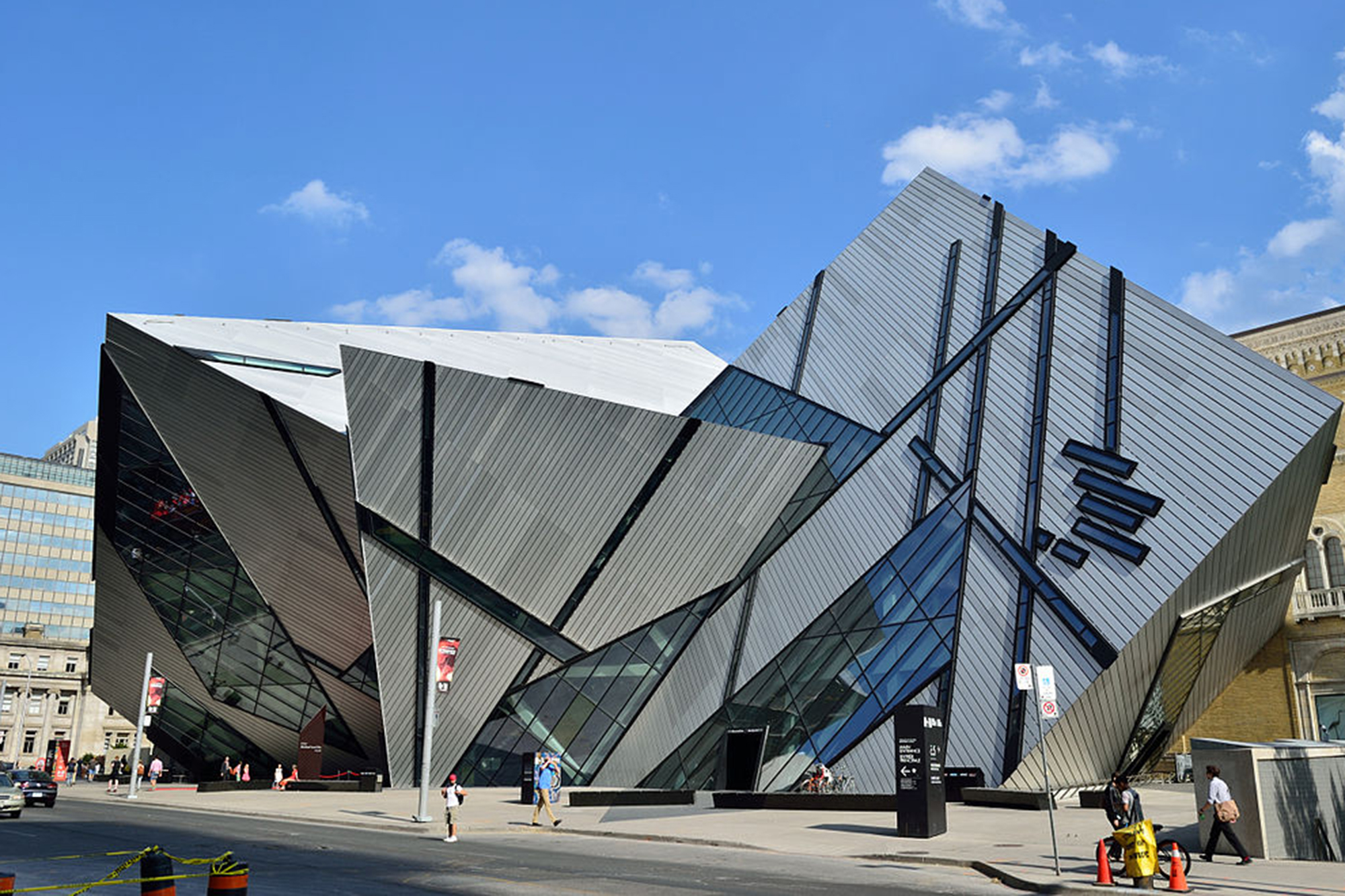
Magnusmode partners with ROM to create digital museum guides for people with autism


As part of National Access Awareness Week, Toronto-basedMagnusmode has partnered with the Royal Ontario Museum and Easter Seals Canada to launch digital museum guides for visitors with autism.
The guides are built off of the company’s Magnuscards platform, which provides step-by-stepillustrated guides for people with cognitive special needs to navigate through daily tasks like doing laundry. Its web and mobile apps use digital guides, called Card Decks, and users to follow instructions from Magnus, the app’s interactive character.
“Museums have a key role to play in helping remove the isolation that can exist for many people with autism,” said Nadia Hamilton, CEO and founder of Magnusmode. Hamilton was inspired to found Magnusmode through her experience growing up with her brother, Troy, who has autism. “We chose to work with the ROM, a world-renowned institution, as our founding museum partner. With this proven model, we can now begin to collaborate with museums across Canada and around the world with tools that enable museums to educate, engage, and inspire all members of the community.”
The ROM MagnusCards feature two decks: one which guides and prepares the visitor for what to expect when entering the ROM, and the other functions as an educational scavenger hunt through the ROM’s James and Louise Temerty Galleries of the Age of Dinosaurs.

Thursday, May 19, 2016

Harvard engineers designed a 'soft wearable robot'

The flexible suit is aimed at patients with limited mobility.


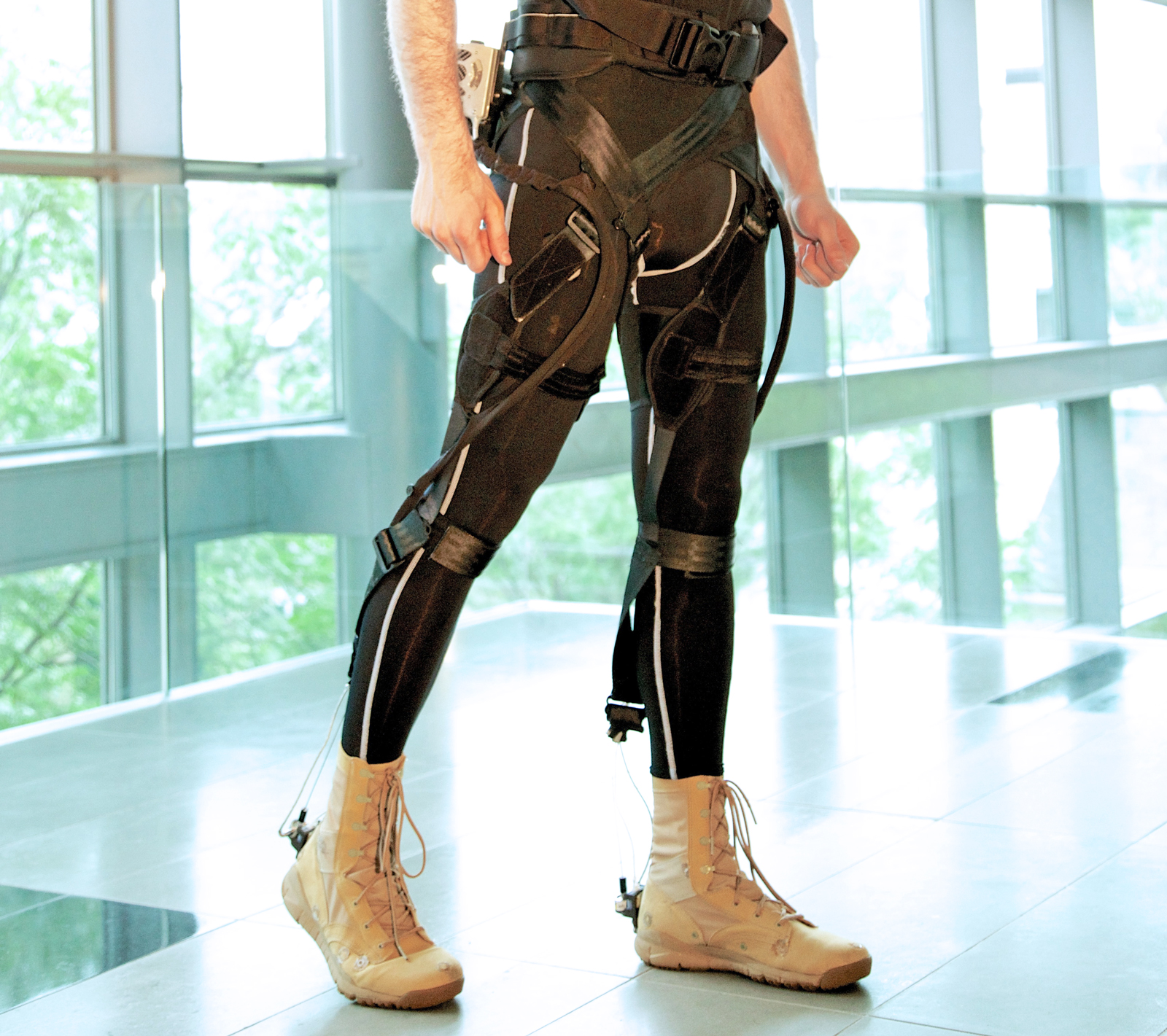
A team of engineers from Harvard University's Wyss Institute for Biologically Inspired Engineering have moved one step closer to a consumer version of a soft, assistive exosuit that could help patients with lower limb disabilities walk again. The Wyss Institute announced todaythat the university is collaborating with ReWalk Robotics to bring its wearable robotic suit to market.
The soft exosuit was designed by Dr. Conor Walsh, who also happens to be the founder of the Harvard Biodesign Lab, along with a team of roboticists, mechanical and biomechanical engineers, software engineers and apparel designers. What really makes the Wyss exosuit stand out from other exoskeletons and robotic suits, is its form-fitting and fabric-based design. Instead of a heavy, rigid frame, the exosuit uses small but powerful actuators tucked in the belt to assist the wearer's legs in a more natural way. While the setup might not be powerful enough to fight off Xenomorphs, it is a much more elegant solution for stroke, MS and elderly patients who still have partial mobility, but need additional assistance.
"Ultimately this agreement paves the way for this technology to make its way to patients," Walsh said of his teams partnership with ReWalk. According to Harvard, the exosuit's development has already had a lasting impact beyond those medical applications as well. As the announcement puts it, the team's work has "been the catalyst for entirely new forms of functional textiles, flexible power systems and control strategies that integrate the suit and its wearer in ways that mimic the natural biomechanics of the human musculoskeletal system."