Friday, February 13, 2015

Watch This Man Scale a Rock Wall With DARPA's Bionic Arm


The DARPA-funded DEKA Arm System is an amazingly life-like prosthetic arm controlled directly by electric signals from the muscles. It's the first such prosthetic available to the general public. And it can help you climb a rock wall like a badass. 
By plugging into the body's electric signals, the DEKA arm allows for close to natural movement. That can mean delicate maneuvers like picking up eggs. It can also mean, as illustrated in this new DARPA video, feats of strength like this Army volunteer amputee scaling a rock wall. Watch out, non-cyborgs. [DARPA]

Monday, February 9, 2015

Access QuickType suggestions in OS X Yosemite

KeyboardIconXIf you have used Apple’s iOS 8 and have enjoyed the new QuickType keyboard that is included with it, then you might be happy to know a similar service that is available in OS X has gained this function in OS X Yosemite.
QuickType is a word suggestion feature that allows you to quickly complete sentences by tapping on one of three suggested words. The suggestions that QuickType offers are contextually based, and therefore will change depending not only on the starting letters you have entered, but also on the context of the sentence you have already typed.
This service has its uses, and if you have become accustomed to it then you might find comfort in knowing the service has made its way into OS X Yosemite.
For a while, OS X has contained a word-completion feature, where by typing a few letters of a word and pressing the escape key you will get a list of possible word completions to use; however, so far this list has been a dumb alphabetical list, which has limited its uses. In Yosemite, this structure has been changed to essentially be the same as the QuickType suggestions, so now when you open this list you get a series of smart suggestions to use.
As with the QuickType keyboard, the suggestions allow you to throw together some ridiculous and funny phrases, but more importantly allow you to better use the suggested word list.
While enhanced, accessing the word suggestions in OS X is still the same: Simply press the escape key whenever you want a suggestion for a word, or for completing a partially-typed word, and a menu will pop up at your cursor with all of the options that OS X thinks are relevant. With the menu open, you can use the arrow keys to highlight a desired word, followed by pressing the space bar, tab key, or enter key to place it in your text.
Word suggestions in OS X Yosemite
The word suggestion list now offers more relevant words based on the context of what you have already typed in your sentence.
Even though its main use might seem to be for suggestions while typing, another approach to using word suggestions is for reviewing text, where if you find a word in a phrase and want to use an alternative, you can highlight it and press Escape, to get a list of relevant alternatives that could work.

Thursday, February 5, 2015

New live music and events platform caters to people with disabilities


About 15% of the global population lives with some form of disability. That means more than one billion people have limited access to appropriate health care and other services, and up to 190 million adults have significant difficulties functioning.
But there's another issue not often talked about: people with disabilities want to have fun, just like everybody else. Unfortunately, the average venue or event doesn't cater to their needs.
Enter Why Not People, a new UK-based members club and online platform for people living with disabilities. The company creates and hosts events such as live music gigs with top talent, built specifically for people with physical, sensory and learning impairments.
In order to become a member, people with disabilities need to provide some basic medical information in an application. But, in an effort to promote inclusion, members can purchase up to three additional tickets for friends and family.
"I have spent the last few years DJing around the UK and globally, and when I look out at the audience, there is not one person in a wheelchair," Jameela Jamil, founder of Why Not People, tells Mashable in an email. " 

What I see is not representative of society. It's embarrassing that we live in a world where that is still the case. And that is what drives Why Not People — to change that, impact people's lives and ultimately break down barriers in the community."

Jamil, perhaps best known as a presenter on BBC Radio 1, had her own experience with disability: In a childhood car accident, she broke several bones, damaged her spine and was confined to a bed for two years. Doctors warned her that she might never walk again, but she eventually recovered through physiotherapy.
Why Not People is her way of ensuring that people with disabilities aren't left out or separated at live events — instead of being cornered off, they'll be in the middle of the action. 
Through an Indiegogo campaign, Why Not People is hoping to raise £40,000 (approximately $60,000) to launch its members' portal, process applications, secure and prepare a venue for the first event, and more. Artists currently on board include Ed Sheeran, James Blake, Tinie Tempah and Coldplay.
In the UK specifically, more than 11 million people reported living with a long-term health problem or disability in a 2011 census. In a Muscular Dystrophy Trailblazers survey, 1 in 2 young people with disabilities said physical access was the primary obstacle preventing them from attending live music events.
Jamil thinks it's high time for change.
"It's unbelievable that a company like this even needs to exist in this day and age," she says in the video above. "But if it has to start with us, so be it."

Monday, January 26, 2015

iBrailler Notes for iPad Brings Easy-To-Use Braille Keyboard to Blind Users


iBrailler Notes for iPad brings an easy-to-use Braille keyboard to blind users, allowing for an easy way to create, edit, and share notes.
The app began as a summer project at Stanford University in 2011 and aims to offer blind and vision impaired iPad users an easy way to create and edit Braille notes.
In order to start typing, place 8 or 10 fingers on the screen. Dynamic keys will appear under your fingertips, allowing you to type comfortably without any screen overlays. Editing your notes is only a simple gesture away, making it easy to navigate through your notes and perform cut, copy, and paste functions to move text to and from your other apps.
iBrailler Notes supports English Braille Grade 1 (uncontracted), English Braille Grade 2 (contracted), and Six-Dot Computer Braille. You can also use your own custom Braille standard, following guidelines in the help section of the App.
Once your note is complete, you can upload it to Dropbox or share it via email. The app allows users to import and export BRF files for use with other Braille software.
iBrailler Note for iPad is available as a free download from the App Store. The app requires a device running iOS 7 or later.

Tuesday, December 23, 2014

Samsung launches “Look at Me” app to help Canadian families living with autism

December 22, 2014 8:05am


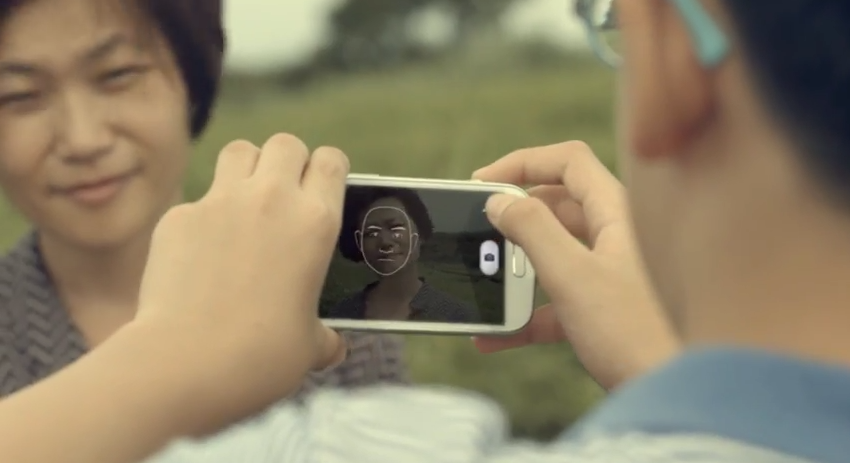
Samsung Canada has teamed up with Autism Speaks Canada to develop an app called ‘Look At Me.’ An interactive camera app, it is designed for kids with autism to help improve eye contact, read facial expressions, and express emotions.
The app has different ‘missions’ and levels that are aimed to keep kids occupied by offering up points, various rewards, and visual or sound effects to keep children engaged. Samsung stated that the recommended time to use ‘Look at Me’ is 15-20 minutes each day.

‘Look at Me’ will be available starting December 23rd and is compatible with Samsung Galaxy Tab S, Note 2, Note 3, Note 4, Galaxy Tab 3, Galaxy Tab 4 and Galaxy Tab 5, and Zoom 1 devices.
Samsung Canada, as part of the Look At Me Project, is donating 200 GALAXY Tab S devices with the app preloaded to 200 Canadian families living with autism.

Friday, December 12, 2014

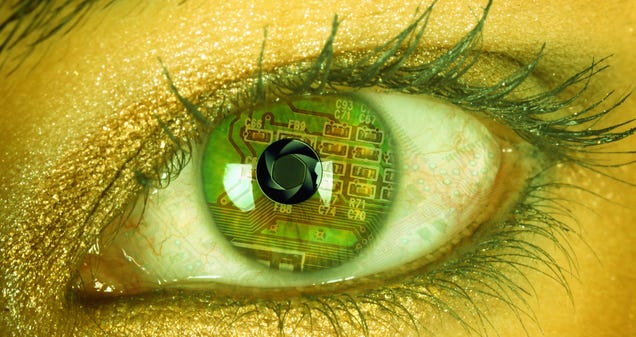
Bionic Eyes Can Already Restore Vision, Soon They'll Make It Superhuman


We now live in an age where radical technology can help the blind to see, an impressive enough accomplishment in its own right that gets even more mind-bending when you consider what's it means for the future. UV vision? Eyeballs that zoom in and out like a camera lens? It's coming!
Scientists 'round the world are working to improve the retinal prosthesis system, or what many people simply call a bionic eye. The leading device in the States is called the Argus II, created by California company Second Sight. It costs about $145,000 and has been used by some 80 visually impaired people in the last few years.
It works by combining an external eyeglass-mounted camera and a sophisticated retinal implant. The camera uses a small microchip to process what it sees, and then wirelessly sends that data to the retinal implant, which has 60 electrodes in it that provide information to the optic nerve—which is what discerns light, movement, and shapes.


But the vision people get with the bionic eye isn't like typical sight. They see contrast and edges of objects, but only in black and white. The ability to naturally see light and color has been eliminated by damage to various cells in the eyes, but with enough use, the brain learns how to make sense of these images that appear from the electrode's signals. Argus II users have reported successfully reading large-print books, crossing the street on their own, navigating an unfamiliar home, or seeing images of their spouse for the first time in decades.
Unfortunately, the Argus II is not able to lift them people out of technical blindness, which in America is 20/200. The best that users have reported is about 20/1000. But upgrades are coming. And here's where things get really interesting.
The next iteration of the Argus II will include the ability to perceive colors, using algorithms that measure electrode stimulations, according to Second Sight. The device will provide sharper images, and be able to focus eyesight like we do a computer screen, increasing resolution and brightness.

Over in Germany, a leading bionic eye product called the Alpha IMS is a self-contained bionic eye—which means instead of an (awkward) external camera, it has a built-in sensor sending signals to the retina. The other major advantage is it uses 25 times the electrodes of the Argus II, which greatly increases resolution. Bionic eye researchers at University of New South Wales in Australia predict there will be a fully functioning artificial eye available by 2020.
The next great leap forward will be to bypass the eye and go straight to the brain. At this point, many visually impaired people aren't able to benefit from the implant, which requires a functioning retina to work. That leaves people with damaged retinas or that have lost their vision to infection, or diseases like glaucoma or diabetes, out of luck. Second Sight is "working on a new implant that bypasses even the retinal layer, and implants electrodes directly onto the visual region of the brain," Second Sight CEO Dr. Robert Greenberg told the BBCA trial for this is currently scheduled for five blind patients with Age-Related Macular Degeneration. This could herald the breakthrough millions of blind people have been waiting for.
It inevitably conjures up scenes from science fiction. Take the ocular enhancements of Star Trek's Geordie La Forge, who has infrared sight, night vision, and telescopic vision. The developments in retinal implant technology now raises the question: Are these these seemingly sci-fi upgrades possible for everyone in the future?
It's a question that's yet to be answered, but there's reason to be optimistic. Some scientists working on bionic devices know the device is not only capable of helping the visually impaired, but, like all bionic devices, giving human beings superhuman ability.
"For me personally, one of the inspirations was Steve Austin, the bionic man," Greenberg recently told Bloomberg TV when asked if his technology could be applied to other industries like gaming. "I think direct interface is probably in the future. I don't know how far out, but it's probably there."
What he means is if researchers can send signals directly to the brain, the brain can learn to interpret those signals and essentially recreate them as a visual image or function. Take telescopic sight, for example, which is already here. We can teach our brains to interpret the powerful zoom-in or zoom-out functions of cameras—we could learn to see much farther and closer than the natural human eye.
In fact, Brian Mech, VP of Business Development of Second Sight, told me, "We could tomorrowallow our patients to see outside the visible spectrum by using a different input device than a visible spectrum camera (an IR camera for example). We can also already provide telescopic vision."
But it gets more bizarre than that. If bionic eyes can see the entire electromagnetic spectrum, that would include infrared vision, heat-sensing capabilities, ability to detect certain gases, and probably even the ability to see right through objects. We could end up with those powers of perception too. We already have devices to measure all these things—the key is shrinking them enough to get them into an implant (or other tethered bodily device) that communicates directly with the brain in a way that renders the input sensible.
It's still speculative, for sure. But far into the future we might become a walking science lab, able to utilize a wide range of devices and applications built into our bionic eyes. The applications would be endless. Soldiers could possess X-ray vision that detects landmines in the ground they're fighting on. Parents could detect dangerous gases in their children's rooms in the same way a carbon monoxide alarm functions. People on first dates might use airport scanner technology to scope each other out, even see what's beneath each others' clothing. If we can project images directly into the visual areas of our brains, we may see things we never imagined, including the millions of microbes living on each of us.
But it gets even more bizarre than that. A robotic eye may able to be set so it never sleeps and will always be on guard, ready to wake you in danger or when it gets light outside. It will also be Wi-Fi enabled, and ready to record your entire life and stream it live on YouTube—or ready to instantly post images on Facebook and Twitter. Or ready to play video games inside your head, like Greenberg alluded to. Your favorite sitcom could play right through the eye into your brain, completely skipping TV.
Currently, the human eye sees about 1 percent of the light spectrum in the universe. That's not much when you think about it. Futurists like myself think that decades from now the bionic eye will improve so much that it will likely see far more than that tiny 1 percent. And because we have two eyes, it seems plausible some people—especially biohacker and cyborg enthusiasts—will replace a biological eye with a bionic eye once that technology arrives. Experience of our universe will never be quite the same.


Monday, December 8, 2014

KID DESIGNS HIS OWN PROSTHETIC ARM AT A SUMMER CAM


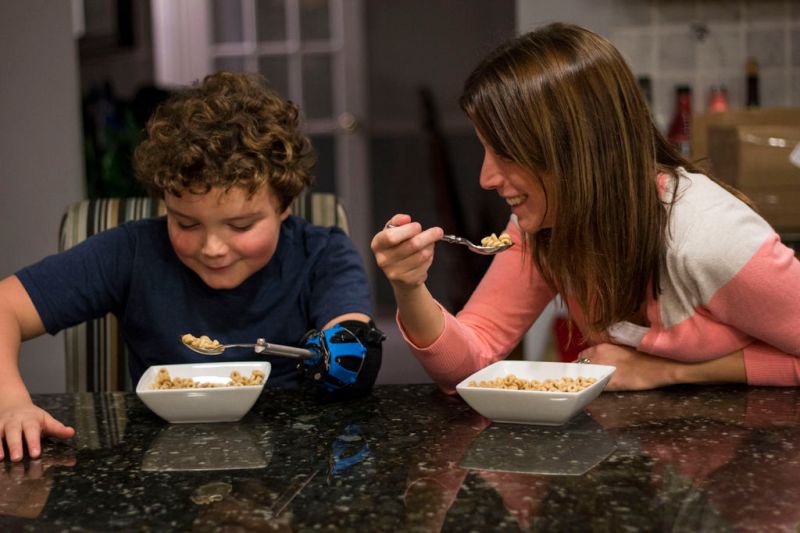
Ever heard of the summer camp called Superhero Cyborgs? It’s where [Coby Unger] met nine-year-old [Aidan Robinson] and helped him design his very own custom prosthetic arm.
The camp is put on by KIDmob for kids who have various limb disabilities, and helps give them the tools and guidance to be able to make their very own prosthetics. Some of the designs the children come up with are cool, useful, pretty and sometimes not overly functional — but [Aidan’s] designs really intrigued [Coby] who is a designer and part of the staff at Pier 9, a world-class fabrication facility (and makerspace) run by Autodesk.
There’s a lot of problems with prosthetics for children. They’re very expensive, kids don’t stay the same size, and even though they might cost a lot, they don’t necessarily work that well. [Aidan] had a few commercial options but didn’t like any of them, so much so that he preferred not wear them period. But when he attended the camp he realized he had the ability to design a prosthetic that he’d actually want to wear.
[Aidan] wanted a prosthetic that could use different attachments specific to what he wanted to do, taking inspiration from a Swiss army knife. He wanted to be able to play the Wii, assemble LEGO, eat food, and even play an instrument. His mom wanted the prosthetic to be able to “grow” with [Aidan]. A tall order? Perhaps, but [Coby] was up to the challenge.
prosthetic
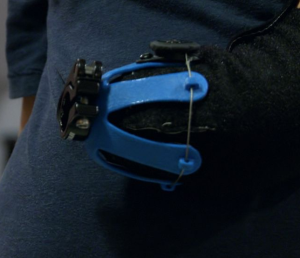
It’s rather ingenious actually. [Coby] designed a flower shaped piece of plastic that can be 3D printed and then thermoformed in warm water to form around the end of a limb.
To tighten it, he stole a ratcheting adjustment system from an adjustable knee strap, allowing for quick installation and removal — something [Aidan] can do himself.
This way as he continues to grow, the prosthetic remains adjustable, and worst case, just needs a new part 3D printed. To allow for the attachment of various tools, [Coby] added a quick release clamping system designed to hold anything with a 1/2″ diameter shaft making it super easy for [Aidan] and his mom to make their own attachments.
3D printing is doing some great things for prosthetics. Earlier this year we saw an Iron Man themed prosthetichand to make kids dreams come true, a cute story about someone making an artistic prosthetic for a random stranger and the introduction of E-nable, a community dedicated to DIY prosthetics — to give the world a “Helping Hand”.
[Thanks Jerome!]